Why Labs Choose the E-Torch
Traditional quartz torches and open-loop designs struggle with high-TDS samples, organics, fusion digests, and wear-metal oils. This is due to plasma instability, rapid tube degradation, and frequent maintenance, which drives up cost and downtime.
The E-Torch was engineered to solve these problems directly: tighter control of annular spacing for stable dual-view performance, a hotter and more robust plasma when the ceramic plasma tube is used, and true injector interchangeability so one torch body can be optimized for virtually any sample type.
Key Features & Benefits
- 30+ Years of Demountable Torch Innovation: Proven demountable torch technology, built on over three decades of innovation, it delivers ease of use, robustness, flexibility, and reliability that have made Glass Expansion’s demountable torches the preferred choice for routine and challenging sample matrices.
- Hotter Plasma. Longer Life: The all-ceramic plasma tube generates a hotter, more robust plasma, reducing matrix effects while delivering measurable improvements in sensitivity. In aggressive sample matrices, ceramic plasma tubes can provide years of service, compared with the shorter time frames often achieved by conventional quartz torches.
- Maximum Plasma Stability: Precision-controlled annular spacing, plus a newly optimized viewing window for the DUO that replaces the traditional open loop, improves analytical stability while extending torch life.
- Higher Aerosol Transport Efficiency: Advanced tapered injector geometry promotes laminar gas flow around the tip, improving transport efficiency, short-term precision, sensitivity, and overall analytical performance.
- Simplified Maintenance: User-friendly retainers ensure precise alignment between the injector and plasma tube and enable quick, repeatable assembly, reducing service time.
- One Torch for Every Application: Fully interchangeable Quartz, Alumina, and Sapphire injectors, available in multiple internal diameters, provide exceptional flexibility for aqueous, organic, high-TDS, fusion, and wear-metal analyses.
Ceramic Plasma Tube: Years, Not Days
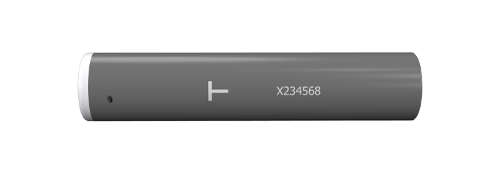
As the pioneer of ceramic torches, Glass Expansion introduces the all-new ceramic plasma tube. Ceramic torches produce a hotter, more robust plasma that reduces matrix effects and improves detection limits. Lifetime matters just as much: compared with quartz, the ceramic plasma tube lasts dramatically longer, cutting maintenance, cleaning, and downtime from torch failure. In some matrices, quartz tubes degrade within hours, in comparison ceramic tubes may last years under the same conditions. The Plasma Tube (ceramic or quartz) can also be placed in a drying oven or muffle furnace to easily bake-off carbon buildup.
- High-TDS samples that quickly devitrify quartz tubes.
- Analyses at the detection limit, as the hotter plasma condition increases sensitivity.
- Monitoring wear metals in engine oils, where quartz tubes crack under thermal shock.
- Fusion sample analysis, where lithium salts rapidly attack quartz.
Comparison of Quartz Plasma Tube to Ceramic Plasma Tube
| Element | % Increase in Sensitivity | % RSD |
| Zn (213) λ | 17% | 0.37 |
| Ni (231) λ | 19% | 0.57 |
| Mn (257) λ | 14% | 0.52 |
Precision Annular Spacing & Optimized Viewing Window
Traditional quartz torch manufacturing methods are limited in terms of tolerance for the annular spacing between the outer and intermediate tubes. This annular spacing affects gas flow rates and, in turn, the stability of the plasma and lifetime of the torch, which can be further compromised when analyzing complex matrices. Therefore, it is important to maintain a precise annular spacing to achieve optimal and reproducible results and maximize the operational life of the torch. Glass Expansion’s proprietary manufacturing capabilities enable superior control of annular spacing, as well as an optimized viewing window for dual-view instruments. The combination of these manufacturing features in the new Thermo PRO E-Torch Plasma Tubes, both quartz and ceramic, helps analysts ensure the greatest plasma stability even in complex matrices. Maximum stability delivers the best precision and lowest detection limits.
Tapered Injector Technology
Glass Expansion's advanced tapered injector geometry promotes laminar gas flow around the tip, improving aerosol transport efficiency, short-term analytical precision, and sensitivity compared with traditional designs.
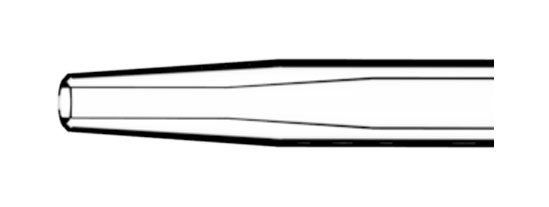
More efficient aerosol transport and improved sensitivity.
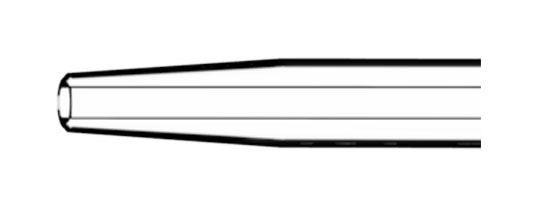
Straight bore ID, typically 0.5–2.5 mm.
Injector Selection Guide
Glass Expansion uses raw materials of the highest purity, helping improve detection limits by keeping background contamination as low as possible. Use the tables below to find the right diameter and material for your matrix.
Choose by Sample Matrix
| Bore Size | ID Range | Best For |
| Narrow Bore | ~0.8–1.0 mm | Volatile organic solvents (ketones, alcohols, aldehydes), smaller ID reduces plasma solvent load to stabilize it |
| Standard Bore | ~1.5–2.0 mm (down to 1.2 mm) | Routine aqueous matrices; also suitable for semi-volatile analyses |
| Large Bore | ~2.0–3.0 mm | High-TDS matrices, large bore prevents blockages from salt deposit build-up near the tip |
Choose by Injector Material
| Material | Best For | Watch Out For |
| Quartz | Routine aqueous and volatile organic analyses. Most cost-effective | Not compatible with HF at any concentration; shorter lifetime; tip can chip easily |
| Alumina (Ceramic) | High temperatures, high TDS, acid resistance, including HF, mineral acids, and aqua regia; also less-volatile organics like xylene | Higher cost than quartz |
| Sapphire | Low-background applications involving silicon, boron, and HF | Premium cost; reserved for high-purity work |
Tip: If you experience salt buildup on your injector tip, pair your E-Torch with our Elegra Argon Humidifier. Learn more about the Elegra Argon Humidifier →
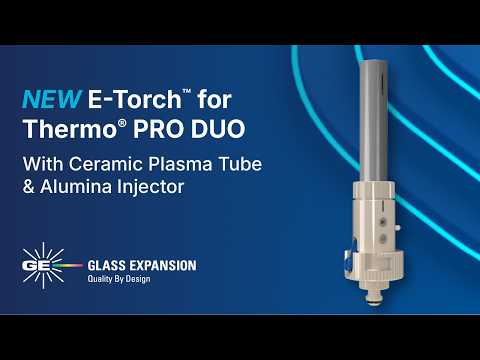
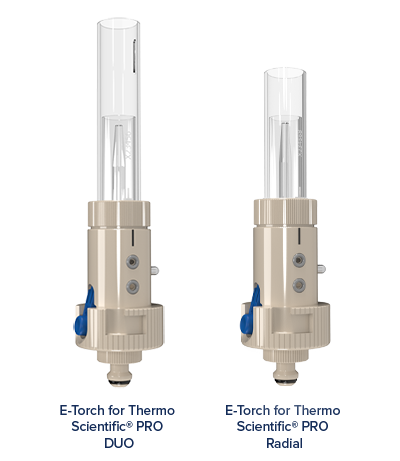
E-Torch for Thermo Scientific® PRO DUO
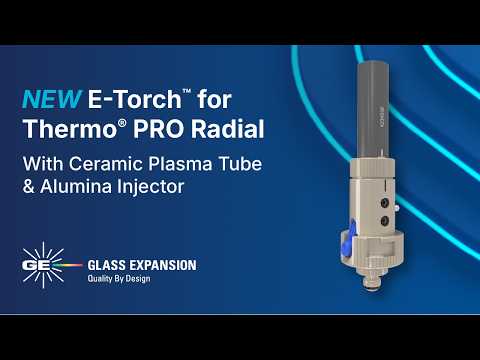
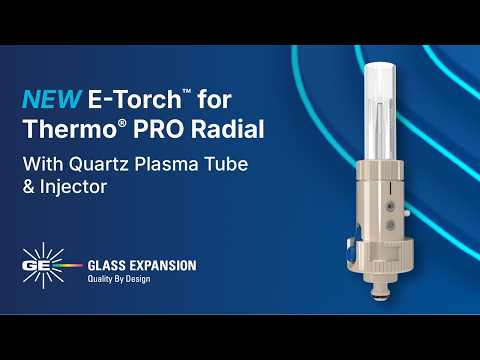
E-Torch for Thermo Scientific® PRO Radial
Ordering Information
E-Torch
| Part Number | Description |
| 30-808-4388 | E-Torch for Thermo Scientific® PRO DUO |
| 30-808-5163 | E-Torch for Thermo Scientific® PRO Radial |
E-Torch Options
| Part Number | Description |
| 31-808-4425 | E-Torch Body |
| 31-808-4498 | Plasma Tube Retainer 22mm |
| 31-808-4582 | S13 Injector Retainer 6.5mm |
| 70-V-011 | Viton O-rings for FDT/SDT S13 ball joints (PKT 10) |
| 31-808-2836 | Capillary Quartz Injector 2.0mm (EMT) |
| 31-808-4381 | FKM O-Rings (PKT 10) |
| 70-803-6475 | Silicone O-rings 22X1.8S70 (PKT 10) |
Plasma Tubes
| Part Number | Description |
| 31-808-4390 | Quartz Plasma Tube for Thermo Scientific® PRO DUO |
| 31-808-4502 | Ceramic Plasma Tube for Thermo Scientific® PRO DUO |
| 31-808-5164 | Quartz Plasma Tube for Thermo Scientific® PRO Radial |
| 31-808-5165 | Ceramic Plasma Tube for Thermo Scientific® PRO Radial |
Tapered Injectors
| Part Number | Description |
| 31-808-3511 | Quartz Injector 0.75mm |
| 31-808-2833 | Quartz Injector 1.0mm |
| 31-808-2834 | Quartz Injector 1.5mm |
Capillary Injectors
| Part Number | Description |
| 31-808-3510 | Quartz Injector 1.0mm |
| 31-808-2836 | Quartz Injector 2.0mm |
| 31-808-3246 | Quartz Injector 2.5mm |
| 31-808-3247 | Quartz Injector 3.0mm |
| 31-808-3279 | Alumina Injector 1.0mm |
| 31-808-2835 | Alumina Injector 2.0mm |
| 31-808-2977 | Sapphire Injector 2.0mm |
Not sure which E-Torch configuration you need, have a question about consumables and replacements, or seeking guidance on installation and maintenance? Reach out to a Glass Expansion Application Specialist for assistance and pricing. Contact Glass Expansion →
See It in Action
Swapping injectors shouldn't slow down your workflow. These short guides walk you through E-Torch assembly and maintenance step by step, so you can get back to running samples faster.
Related Documents
Join Our Mailing List
Trusted by ICP-OES and ICP-MS analysts worldwide, providing expert tips, event highlights, and new product spotlights.
Thank you
You have been added to the Glass Expansion mailing list.