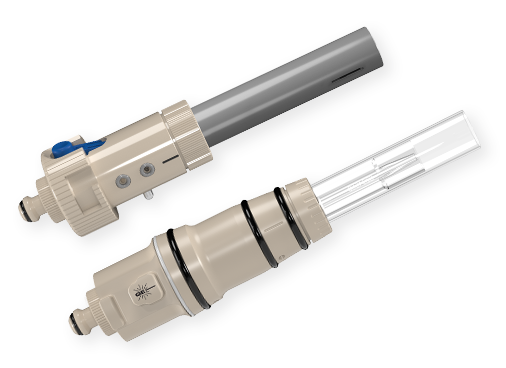
Handling, Storing and Transporting Torches
Glass Expansion quartz and ceramic torches are made from high-quality materials, so you should exercise the same care that you would normally use for glass labware. In particular, don't knock a torch against hard objects or leave it unprotected when not in use.
Quartz should be treated with the care that is due to a brittle material. It can fracture and produce sharp, cutting edges, so handle all quartz objects with deliberate movements and don't apply large mechanical forces to them, especially when connecting gas tubes or installing them in the torch holder. All quartz torches are supplied in a box with soft sponge foam. This should be used when the torch is placed in storage. Don't touch quartz torches with bare hands, as this can reduce the torch's life. Don't use metal or ceramic brushes or scraping tools. Damage is quite likely to result from doing this.
Temperature
If the quartz torch reaches a temperature above the melting point of quartz, then clearly it will melt. The most common cause of a melted torch is incorrect argon flow. It is critical that the plasma does not contact the quartz, and it is the flow of argon that holds the plasma in position and prevents it from contacting the torch. If the argon flows are not set correctly, if there is an interruption to the flow, or if there is a leak in the argon lines, then it is possible to see an instant torch meltdown.
Glass Expansion recommends the use of GazFit connectors for the reliable connection of the argon lines to the torch. Improper alignment of the torch within the RF coil is another potential cause of torch degradation. Therefore, it is important to ensure proper alignment of the coil when it is replaced. Glass Expansion offers a coil installation and alignment tool to be used with its line of RF coils. If the correct argon flows are maintained and the torch is positioned correctly in the RF coil, then the torch should not melt. However, high temperatures will still contribute to the devitrification of the quartz over time. So, devitrification is likely to occur faster with those applications where the torch is run at higher temperatures.
Daily Maintenance & Handy Tips
It is good practice to always start and finish the use of a torch by nebulizing a mildly-acidic blank solution for several minutes. This ensures that sample deposits or crystals don't form inside the torch injector bore when the solvent inside the injector dries out.
Contamination can also be caused by handling of the quartz with bare hands. It is important to always use safety gloves when handling quartz torch components. If the quartz components are handled with bare hands, body oils may be deposited on the surface. These oils can accelerate the devitrification of the quartz and significantly reduce the torch's lifetime.
Important note:
HF (hydrofluoric acid) should not be used with glass or quartz. Using any amount of HF will damage the product. Our quartz torches are supplied clean and ready to use. Please do not pre-treat torches with HF.
Care & Maintenance
Do NOT place plasma tube in ultrasonic bath.
Inspect O-rings, injector, and plasma tube regularly for wear, contamination, or damage. Clean or replace components as required to maintain proper sealing, alignment, and torch performance.
The ceramic materials used in the E-Torch generally require less cleaning than quartz components. Most deposits can be removed using a damp cloth or non-abrasive scourer. More stubborn deposits may require the cleaning methods described below.
Organics
Carbon deposits resulting from organic samples can be removed by baking the plasma tube in a muffle furnace at approximately 500°C.
Salts
Salt deposits are best removed by soaking the plasma tube in a 25% solution (4x dilution) of Fluka RBS-25 (manufactured by Sigma-Aldrich, and is available from most suppliers of laboratory chemicals). Do not wash the plasma tube in an ultrasonic bath as this will damage the plasma tube.
Metals
Metallurgical samples with high metal content may result in a metallic film being deposited on the plasma tube. This conductive film may interfere with the RF field and should not be allowed to build up. Metallic films are best removed by soaking the plasma tube in acid. The best acid to use is usually the one that was used to prepare the samples.