NEWS
Auxiliary Gas Flow Mn 257 As 189 Pb 220
Intensity (cps) RSD (%) Intensity (cps) RSD (%) Intensity (cps) RSD (%)
0.8 L/min 4,679,360 0.15 105,734 0.38 170,613 0.41
1.0 L/min 4,587,320 0.44 119,154 0.48 184,956 0.28
Table 3: Comparison of optimization data for ceramic D-Torch at 0.8 L/min and 1.5 L/min auxiliary gas flow.
A Fully Ceramic Demountable Torch
Even after optimizing the sample introduction system for high TDS, a combination of high temperature and salt deposit causes a quartz torch
to devitrify. Higher concentrations of salt in the samples lead to more rapid devitrification. The disadvantage of a single-piece torch is that it is
a relatively high cost consumable item that requires regular maintenance and replacement, particularly with more demanding samples, such as
HF, organic solvents or high TDS.
The Glass Expansion D-Torch is a revolutionary new torch design, providing the benefits of a demountable torch at a significantly lower cost
without sacrificing performance. The D-Torch incorporates a ceramic intermediate tube for greater robustness and provides the analyst with an
outer tube (quartz or ceramic) which can be replaced when it fails rather than replacing the entire torch. A ceramic outer tube is of particular
benefit for the analysis of difficult sample matrices such as high TDS and HF. The D-Torch also features an interchangeable injector, allowing
the analyst to have a specific injector for each application whether aqueous, organics, high TDS or HF. Having a demountable torch also
allows for easy maintenance and cleaning.
The D-Torch is currently available for a range of ICP-OES and ICP-MS
instruments. In this report we feature the release of the D-Torch for
the Spectro Arcos EOP (Axial) ICP-OES, shown in Figure 2. Inorganic
Ventures has found the benefits of a fully ceramic D-Torch to also
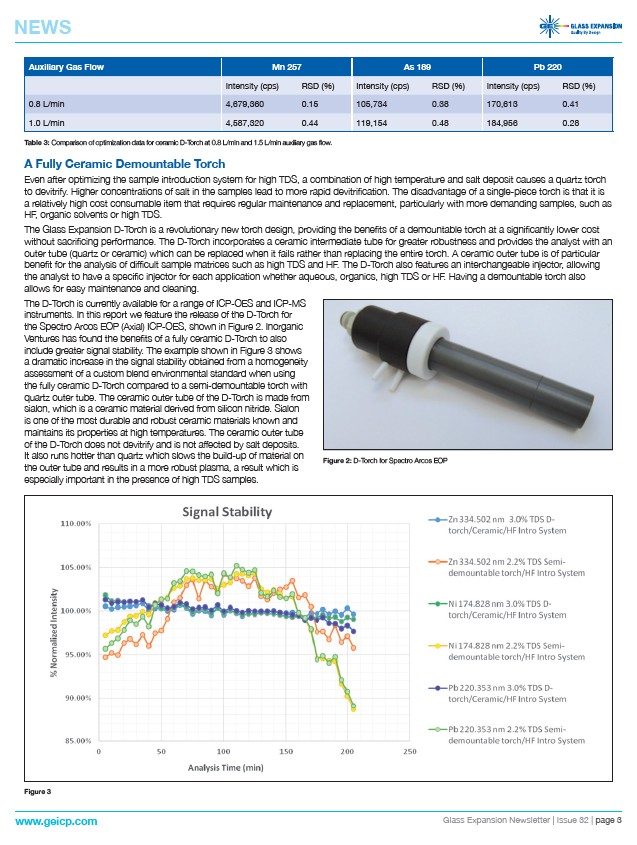
include greater signal stability. The example shown in Figure 3 shows
a dramatic increase in the signal stability obtained from a homogeneity
assessment of a custom blend environmental standard when using
the fully ceramic D-Torch compared to a semi-demountable torch with
quartz outer tube. The ceramic outer tube of the D-Torch is made from
sialon, which is a ceramic material derived from silicon nitride. Sialon
is one of the most durable and robust ceramic materials known and
maintains its properties at high temperatures. The ceramic outer tube
of the D-Torch does not devitrify and is not affected by salt deposits.
It also runs hotter than quartz which slows the build-up of material on
the outer tube and results in a more robust plasma, a result which is
especially important in the presence of high TDS samples.
Figure 3
Figure 2: D-Torch for Spectro Arcos EOP
www.geicp.com Glass Expansion Newsletter | Issue 32 | page 3
/www.geicp.com
/www.geicp.com